NBI Clearance Validity 2026: Expiration Rules and Renewal Time
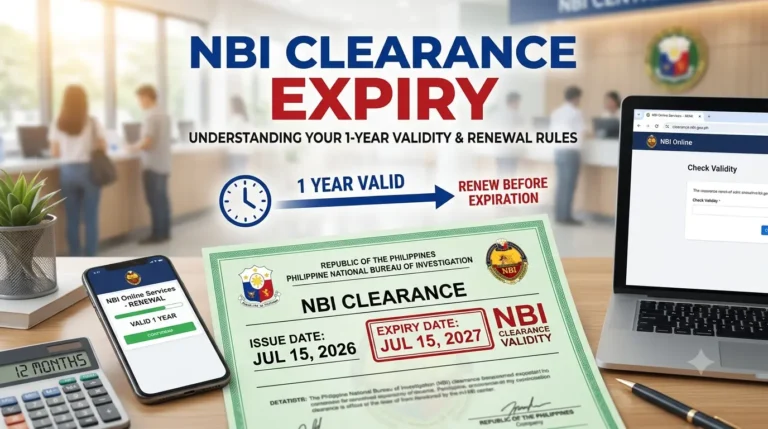
The official rule is straightforward: your NBI clearance validity is for exactly one year from its date of issuance.
These timeline parameters are explicitly stamped on the face of the physical certificate. Once this expiration date passes, the NBI clearance becomes invalid, making it instantly unacceptable to any employer, embassy, or government bureau.
The Practical Reality Gap: Do not rely solely on the technical one-year expiration window. In practice, official validity and institutional policy often diverge.
A high percentage of Philippine employers and foreign embassies mandate that your clearance be issued within the last 3 to 6 months—even if your current certificate hasn’t technically hit its expiration mark. Consequently, its utility can diminish long before the NBI officially treats it as lapsed.
How Long Is NBI Clearance Valid?
An NBI clearance validity is for 12 months from its date of issuance, irrespective of the intended application path—whether it is finalized for local employment, visa processing, international travel, state-level transactions, or corporate business licensing.
This uniform one-year regulatory span applies universally to all profiling categories: first-time applicants, renewal applicants, Overseas Filipino Workers (OFWs), and foreign nationals securing clearances within the country.
The Activation Metric
The validity countdown triggers precisely on the release date—not the day you finalized your calendar NBI appointment booking, and not the date you processed payment via digital channels. For instance, if you initialized your submission on April 10 but the branch officially prints and releases your document on April 15, your certificate remains active until April 15 of the subsequent calendar year.
Administrative Notice: Options to purchase or request an extended multi-year validity period do not exist within the NBI framework.
Where to Find Your NBI Clearance Expiry Date
On the Physical Document
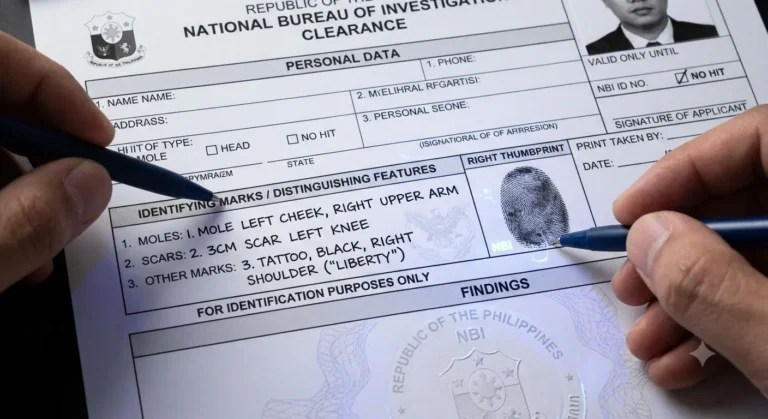
The expiration metrics are rendered legibly on the certificate canvas. Scan the lower section of your document layout—the system lists both the exact issue date and final validity termination date adjacent to each other. No manual tracking calculation is required.
Via the Online Portal
If your physical paper record is unavailable, sign in to your dashboard clearance.nbi.gov.ph and check the Transactions tab. Your chronological processing archive saves the historical issue date, enabling you to trace the exact expiration timeline (precisely 12 months post-issuance).
Proactive Archive Tip: Take a clear photo of your security clearance certificate the moment it is released into your hands. Preserve this digital snapshot in an accessible cloud directory—monitoring the creation timestamp on your screen serves as an instant metric for when you need to activate a renewal protocol.
What Happens If You Submit an Expired NBI Clearance?
An expired security certificate possesses absolute zero legal or corporate transactional weight. Regardless of how recently it lapsed, background screening nodes will reject its profile instantly. Submitting a non-current layout yields swift procedural roadblocks across multiple vectors:
The system offers no grace extensions or leeway adjustments. The exact calendar day following its expiration marker, the document’s validity cuts off entirely. The singular solution is initializing a renewal process—requiring a full system re-submission alongside the base fee of ₱155.
The 6-Month Rule: When 1 Year Is Not Enough
Many foreign agencies and employers request a NBI clearance validity issued within the last six months, even though the official validity spans a full year. Your clearance can be technically valid according to its calendar timeline and still get rejected because it is deemed too old for that specific administrative requirement. Always verify the parameters of the receiving institution before making your final submission.
Purpose | Official Validity | What Most Institutions Actually Prefer |
|---|---|---|
Local employment (Private Sector) | 1 Year | Issued within 3–6 months |
Government employment | 1 Year | Issued within 3–6 months |
Visa application (Embassies) | 1 Year | Issued within 3–6 months |
DFA passport renewal | 1 Year | Issued within 6 months |
OFW / POEA processing | 1 Year | Issued as recently as possible |
Board exams (PRC) | 1 Year | Check with PRC directly |
Business permits | 1 Year | Issued within 1 year is usually accepted |
The Proactive Baseline: Renewing your document every 6 months is the safest operational approach if you are actively job hunting, processing visa files, or deployed as an OFW. It requires the baseline ₱155 layout but eliminates all guesswork regarding whether your metrics comply with an office’s internal freshness requirement.
Job seekers frequently need to process early renewals prior to official document expiration, particularly when maneuvering job changes or transitioning to government agencies and multinational environments.
The practical rule: If you are presenting your clearance for employment or visa clearance, do not assume a 10-month-old certificate will sail through easily. Verify the specific guidelines of the receiving agency first.
OFW Validity Considerations
International Logistics & Buffer Management
OFWs face one extra complication that domestic applicants do not. Although the technical NBI Clearance validity remains exactly one year, practical operational challenges arise due to delivery transit times—international shipping channels can consume up to two full months. This means OFWs must trigger their renewal protocol well in advance, particularly when utilizing the documentation for visa extensions, corporate employer transfers, or permanent residency applications abroad.
If your deployment agency or overseas employer enforces a strict 6-month document freshness window, you must mathematically factor in that delivery latency. Initiating a renewal three to four months before your target administrative deadline is not overcautious—it is the correct operational timeline.
When Should You Renew Your NBI Clearance?
The NBI system permits early application processing up to three months prior to your active NBI clearance validity to expiration marker; waiting until the absolute final expiration day is unnecessary. When you execute an early renewal, the validity mechanism resets completely, rendering the certificate valid for one full year starting from its unique issuance date rather than extending from the old document’s terminal date.
Structural Reset Example: If your legacy clearance is slated to expire in May 2024 but you process an early renewal in March 2025, your newly minted clearance remains officially valid until March 2026. The early processing action entirely updates and resets your validity timeline parameters.
Determine your optimal renewal timeline based on your immediate situational landscape:
Actively Job Hunting
Initiate a renewal the moment you launch your job search application suite—particularly when targeting state positions or multinational conglomerates that strictly demand a security clearance produced inside the previous 3 months.
Applying for a Visa
Review the target consular embassy’s strict guidelines and back-calculate your timeline directly from your formal submission date. If their criteria call for a certificate under 6 months old, adjust your booking calendar accordingly.
No Immediate Need
Execute your renewal safely within a 30 to 60-day buffer zone preceding your document’s official expiration date. This strategy keeps your security profiling continuously active on state ledgers without unnecessary over-renewal fees.
Frequently Asked Questions
Final Thought
The statutory one-year lifecycle is what the NBI prints on your physical document [cite: x]. However, the strict 3-to-6-month freshness threshold is the practical parameter most employers and foreign embassies execute when you hand your documentation over for vetting.
Monitoring both of these numbers—and verifying the explicit internal guidelines of whatever administrative node requests your certificate—is exactly what insulates you from delayed submissions or last-minute scrambles.
As a standard rule, trigger your renewal protocol two to three months early if you are actively scouting employment opportunities or navigating an upcoming visa application track. For all general needs, keep your document expiry milestones noted in your calendar so they do not sneak past you undetected.