Complexion in NBI Clearance Form: All Options Explained 2026
When you fill out your NBI Clearance application online, one field catches many applicants off guard—“Complexion in NBI.” Most people either overthink it, guess randomly, or quietly panic, wondering if the wrong choice will affect their clearance status.
The quick answer? It will not. But filling it out correctly still matters for profile accuracy. This guide breaks down exactly what complexion means in the NBI form, what every option covers, how to choose the right one for your skin tone, and what happens if you make a mistake.
What Does Complexion Mean in NBI Clearance?
Complexion in the context of your NBI Clearance simply means your natural skin tone—the overall color and shade of your skin as it appears under normal, neutral daylight. It is an entirely objective marker that has absolutely nothing to do with beauty standards, race, or ethnicity. The National Bureau of Investigation (NBI) collects it purely as a physical descriptor for identity verification.
Data Category
Physical Descriptor
Input Mechanism
Preset Dropdown List
Primary Purpose
Identity Verification
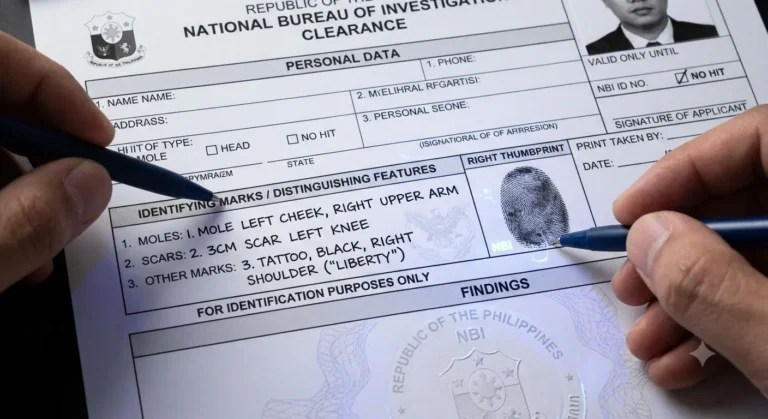
Think of it the same way you think about height and weight markers on any standard government ID. Complexion functions as an additional text-based data point in your official NBI profile matrix, sitting right alongside your photo capture, biometric fingerprints, recorded height, and distinctive identifying marks. It helps paint a more complete, holistic picture of who you are on paper, making your database record easier to verify against your physical self in real life.
Application Protocol Note: The official portal provides a preset list of specific categories to choose from. You do not type out your own customized description—you simply select the established category that most closely aligns with your natural skin tone.
Why Does the NBI Require Complexion?
The NBI processes millions of clearance applications every year. With thousands of Filipinos sharing common surnames like Reyes, Santos, Garcia, and Cruz, physical descriptors become essential tools for telling applicants apart.
Prevent Mistaken Identity
When two applicants share identical legal names and birthdates, baseline descriptors like complexion, height, and identifying marks verify distinct data records.
Database Consistency
Your recorded skin tone is stored alongside biometric vectors. Keeping this consistent during future renewals accelerates the validation lifecycle.
Resolve “Hit” Delays
If your profile flags an administrative match, verification staff manually audit physical markers against the record to rule out false matches swiftly.
Block Identity Fraud
A rigorous, comprehensive set of visible physical markers secures your identity, preventing malicious entities from easily impersonating your name.
Crucial Processing Rule: Your complexion descriptor has absolutely zero bearing on whether your clearance is approved or denied. It functions strictly as a neutral, factual database identifier—nothing more.
All NBI Complexion Options Explained
The NBI online registration portal features six static complexion categories in its drop-down menu. Review this structural breakdown to choose the correct setting for your profile:
Fair
Refers to a very light or pale skin tone. Individuals matching this selection have minimal surface skin pigmentation, experience rapid sunburn under direct solar exposure, and generally possess lighter overall physical features. Common among light-skinned native lines or mixed-heritage applicants.
Brown
The single most widely selected complexion marker across the demographic landscape. It encapsulates everything from light tan up to medium brown ranges. If your skin tone is culturally recognized as kayumanggi, morena, or moreno, this is your safest choice.
Dark
Covers deep brown to intense, heavily pigmented skin tones that sit visibly deeper than standard brown boundaries. Individuals under this setting feature rich melanin profiles, deep tanning adaptation, and rare instances of sunburn. Choose this if your skin sits clearly beyond standard tan parameters.
Red
A specialized selection denoting a natural rosy, ruddy, or consistently flushed skin undertone background. This does not describe temporary heat flushes or active sun exposure irritation, but rather a permanent pigment characteristic. Select this only if your skin displays permanent reddish tones.
Quick Reference: Which Complexion Should I Choose?
NBI Complexion Option | Skin Tone Description | Most Common For |
|---|---|---|
Fair | Very light, pale, burns easily | Light-skinned Filipinos, mixed heritage |
White | Extremely pale or bright | Foreign nationals, very pale skin |
Yellow | Light with golden/yellow undertones | Chinese-Filipino, East Asian, warm-toned |
Brown | Light tan to medium brown (morena/moreno) | Most Filipinos — widest range |
Dark | Deep brown to very dark | Darker morena/moreno tones, high pigmentation |
Red | Naturally rosy or reddish undertone | Rare — permanent reddish skin cast |
Ultimately, Brown is the best choice for the vast majority of Filipino applicants because it encompasses the widest natural range of local skin tones within the region.
If you ever find yourself uncertain between two adjacent options, always select the one that accurately matches how your skin surface appears in natural daylight—not under artificial indoor lighting, not right after temporary sun tanning, and completely free of cosmetic makeup.
How to Select Your Complexion on the NBI Form
Whether you are applying for the very first time or submitting a renewal request, the core baseline configuration process remains identical. Follow this practical framework to fill out your field smoothly:
Does Complexion Affect NBI Clearance Approval?
Absolutely not. Your selected complexion choice exerts completely zero influence over whether your overall NBI Clearance state is instantly approved, delayed, or flagged by the automated routing engines.
System approval metrics are tied entirely to your active criminal record history status. If your complete identity string matches no negative records within the national infrastructure, your documentation is cleared for immediate printing—whichever specific drop-down option you clicked. Conversely, if your name triggers a database match, an official “Hit” is declared, and your profile undergoes manual review regardless of the skin tone value saved.
The only isolated operational scenario where physical characteristics come into play is during the visual resolution of an active Hit verification process. In this situation, bureau analysts review your profile parameters against the specific historical entity flagged inside the system. Even in this scenario, complexion stands as just one minor parameter among several distinct physical indicators—meaning a slight mismatch will never trigger an application rejection on its own.
Complexion vs. Skin Type — What Is the Difference?
This is a question many first-time applicants get confused about. Here is the straightforward distinction:
Complexion
Your baseline physical skin color or shade spectrum (e.g., Fair, Yellow, Brown, Dark). This is the only field requested on the NBI database layout.
Skin Type
Your surface skin behavior, moisture balance, and cellular texture (e.g., oily, dry, combination, sensitive). This is a cosmetic skincare term and holds no role in a government verification profile.
When the registration form prompts you for your complexion data, it parameters color values uniquely—it does not track whether your skin surface builds up oil properties by midday.
Can You Update Your Complexion on NBI Records?
Yes, you can comfortably update this parameter. Adjustments typically resolve under two distinct application scenarios:
1. Minor Adjustments During Online Renewal
If your previously recorded skin tone description no longer represents your physical appearance—due to natural variation over extended timelines—simply drop down and click your newly updated option when preparing your upcoming online renewal via nbi.gov.ph.
2. Correction on an Existing Active Profile
To rewrite an incorrect selection before your standard renewal cycle approaches, drop by the physical NBI branch center that originally handled your processing. Bring your primary valid government-issued ID card alongside your latest physical copy of the NBI Clearance; onsite staff can input a manual profile change immediately.
Core Processing Realities: A minor baseline deviation or slightly imprecise complexion entry will never trigger an execution rejection during automated renewal matching. The bureau understands physical descriptors shift naturally alongside aging, systemic health parameters, and sun exposure levels. Consistent profiling is recommended, but moderate adjustments remain standard practice.
Common Mistakes to Avoid
Leaving the Entry Field Blank
The complexion category drop-down forms an essential, mandatory verification point. Omitting a value completely causes submission loops to flag your dataset as unfinished. When strictly unsure, mark Brown—it safely maps the vast majority of local traits.
Choosing Desired Trait Over Reality
This registration parameter acts strictly as an administrative identifier rather than a personal beauty metric. Input real, current physical attributes. Onsite bureau specialists evaluate your visible presentation directly inside the camera photo frame.
Alternating Choices Across Renewals
Modifying your chosen value randomly across subsequent applications flags irregularities in database matching scripts during validation checks. Isolate your closest matching metric and stick to it permanently.
Profiling Artificial or Tanned Finishes
Your true profile descriptor reflects everyday natural tone values. Present yourself at the physical capture booth with a neutral face—free of high-coverage liquid foundations, dark concealers, or digital filters. The raw image captured by the agent serves as your official identifier.
Tips for Filling Out the Complexion Field
Check your skin in morning daylight. Early morning natural light before intense outdoor solar conditions develop yields the most neutral, accurate presentation of your baseline shade. Avoid selecting values using bathroom mirrors, as domestic lightbulbs are highly misleading.
Ask someone who sees you regularly. If you hit an impassable decision barrier between adjacent choices, verify with a family member or peer. Individuals observing your appearance daily in natural contexts routinely offer an objective assessment of your true skin tone.
When in doubt, choose Brown. This classification dominates database selections across local applications and encompasses the widest segment of regional pigmentation. Falling anywhere inside light tan or medium brown ranges makes this your safest, most logical configuration choice.
Do not wear heavy makeup to your appointment. Your facial layout is digitally saved during the biometric profile processing step. Heavy foundation bases alter your recorded look on screen; enter your biometric session with a clean face to maintain parity between your declared parameter and digital photo.
Be consistent across all government records. Your skin tone markers may propagate across integrated profiles like your PhilSys National ID, local Police Clearances, and Department of Foreign Affairs passport structures. Standardizing this text choice rules out formatting frictions.
Do not confuse “Yellow” with being pale. Selecting Yellow indicates a specific warm, golden, or yellowish undertone matrix rather than an explicit skin brightness level. If your physical tone displays a distinct golden cast even at medium brightness values, Yellow is the correct choice.
FAQs
Final Thoughts
The complexion field in your NBI Clearance application is one of the simplest sections to fill out — once you understand what it is actually asking. It is not a beauty rating, a race category, or a screening tool. It is just your natural skin color, recorded to keep your identity profile accurate and complete.
Look at your skin in natural daylight, pick the option that honestly matches what you see, and move on. For most Filipinos, the answer is Brown. If you have any doubts about your specific situation, drop a comment below and I will help you figure out the right choice.